Oatmeal Chocolate Chip Cookies
Chewy in the middle, crisp at the rim, with oats you can still see. The dough rests overnight and it matters.
- Prep
- 20 min
- Cook
- 12 min
- Rest
- 12 hr
- Makes
- Makes 24 cookies
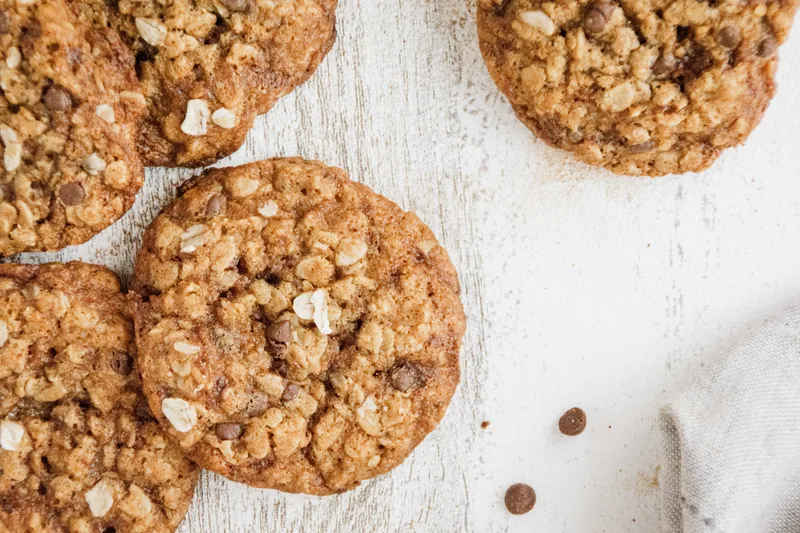
Two decisions make this cookie, and neither is in the ingredient list.
The first is rolled oats, not instant. Instant oats are pre-cooked and rolled thinner; they dissolve into the dough and give a cookie that is uniformly cakey. Rolled oats stay whole, absorb moisture slowly, and give you something to chew against. You should be able to see them in the baked cookie.
The second is the overnight rest. Oats and flour need time to hydrate, and while they do, enzymes break some of the starch down into simpler sugars. Those sugars brown more readily, so a rested dough bakes darker, tastes more caramelized, and spreads less because the flour is no longer competing for water. A batch baked immediately against a batch rested twenty-four hours is not a subtle comparison — the rested one wins on every count. Twelve hours gets you most of the way. The same overnight rest helps blueberry oatmeal bars, for the same reason. The oats themselves do something different in an apple crisp topping, where cold butter fries them crunchy instead of letting them soften.
Brown sugar outnumbers white two to one here, and that ratio is what chewiness actually is. The molasses in brown sugar is hygroscopic — it holds onto water rather than letting it bake off — so the finished cookie stays soft in the middle for days. It is also faintly acidic, which gives the baking soda something to react with, and soda left over after that reaction raises the pH of the dough and pushes browning along faster still. Swap to all white sugar and you get a paler, crisper, snappier cookie. That is a real cookie, just not this one.
Pull them at twelve minutes, when the centers still look underdone and slightly wet. They finish on the tray. A cookie baked until the middle looks done is a cookie that will be hard by the time it cools.
The cue is easier to read than it sounds. At the right moment the outer inch is set and gone golden, the middle is still pale, puffed and glossy, and a gentle nudge of the tray makes the center ripple like a set custard. That ripple is sugar and butter still liquid in the middle, and it firms into chew as the cookie cools. Wait for it to stop moving in the oven and you have waited two minutes too long.
Room-temperature eggs are not a fussy detail. Cold eggs hitting creamed butter drop its temperature below the point where it holds air, and the fat seizes into visible flecks — the mixture looks curdled, and the aeration you spent three minutes building collapses. If you forget, put the eggs in warm water for five minutes.
And leave the dough a little rough. Flour develops gluten the moment it meets water and keeps developing it as long as the mixer runs, and gluten in a cookie reads as tough rather than chewy. Stop while streaks are still showing; the oats and chips you fold in afterward will finish the mixing for you.
Neither of the two decisions above applies to chocolate mayonnaise cake, which gets its texture from an emulsion instead. Swap the chips for candy-shelled mini eggs in the spring, on the other hand, and you are most of the way to Easter cookies — with one change, that the eggs go in at the last possible minute so their shells keep their color.
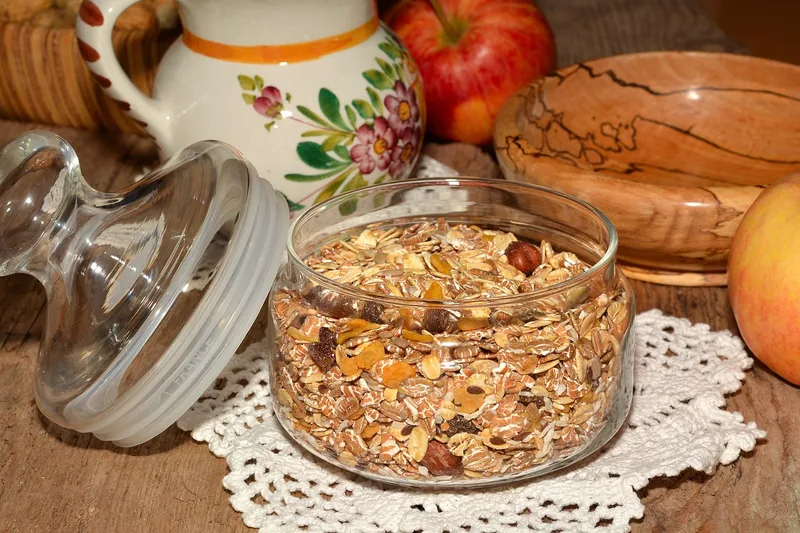
Chewy oatmeal cookies: the recipe card
Chewy in the middle, crisp at the rim, with oats you can still see. The dough rests overnight and it matters.
Everything in one bowl
- 1 cup (225 g) unsalted butter, softened
- 1 cup (200 g) light brown sugar, packed
- ½ cup (100 g) superfine sugar
- 2 eggs, room temperature
- 2 tsp vanilla extract
- 1½ cups (190 g) all-purpose flour
- 1 tsp baking soda
- 1 tsp fine salt
- 1 tsp ground cinnamon
- 3 cups (270 g) rolled oats
- 2 cups (340 g) dark chocolate chips
- Flaky salt, to finish
Mixing, resting, baking
- 1 Beat the butter with both sugars for 3 minutes, until pale and visibly lighter in volume. This is aeration, not just mixing — it is what stops the cookie being dense.
- 2 Add the eggs one at a time, beating well after each, then the vanilla.
- 3 Whisk the flour, baking soda, salt and cinnamon together and fold in until barely combined. Stop while streaks of flour are still visible.
- 4 Fold in the oats and chocolate chips. The dough will be stiff.
- 5 Cover and refrigerate at least 12 hours, ideally 24. Do not skip this.
- 6 Heat the oven to 350°F (180°C) convection. Roll 2 oz (55 g) balls, space them well apart on lined trays, and bake 11–12 minutes — the edges set, the centers still pale and soft.
- 7 Scatter with flaky salt and leave on the tray 5 minutes before moving. They firm up as they cool.
Freezing the dough
- The dough keeps 4 days refrigerated and freezes rolled into balls for 3 months. Bake from frozen, adding 2 minutes.
- Rolled oats only. Instant oats give a cakey cookie with no chew; steel-cut oats stay hard and gritty.
- Chopped chocolate from a bar melts into pools where chips hold their shape — chips are formulated with less cocoa butter for exactly that reason. Use whichever look you want.
- Swap half the chocolate for raisins, dried cherries or toasted pecans without changing anything else. Soak dried fruit in hot water for 10 minutes first or it pulls moisture out of the dough.
- Baked cookies keep 5 days in an airtight tin. A slice of bread in the tin keeps them soft; they go hard within a day left uncovered.
- Bake one tray at a time on the middle rack. Two trays at once means the lower one browns underneath and the upper one runs pale, even in a convection oven.
Why chewy oatmeal cookies need a rest
You will get a decent cookie without it. You will get a noticeably better one with it — darker, deeper, chewier, less spread. Twelve hours captures most of the benefit.
Warm dough, warm trays, or both. Chill the dough properly and let trays cool completely between batches.
Usually too much flour, and usually from scooping it with the measuring cup, which packs in as much as 25 percent extra. Spoon the flour into the cup and level it, or weigh it. The other cause is instant oats, which absorb water instantly and behave like extra flour rather than like oats.
Yes, and frozen balls are arguably the best version — the dough is fully hydrated and the cold center slows the spread, so you get a taller cookie with a chewier middle. Add 2 minutes and look for the same cue: set edges, a middle that still ripples.
Two ounces (55 g) gives 24 cookies and is what the bake time assumes. Size changes the outcome more than people expect, because a cookie cooks from the outside in — smaller balls set through before the center can stay soft, so they end up crisp all the way. If you want them smaller, use 1 oz (30 g) and cut the bake to 9 minutes.
More from the cookie jar
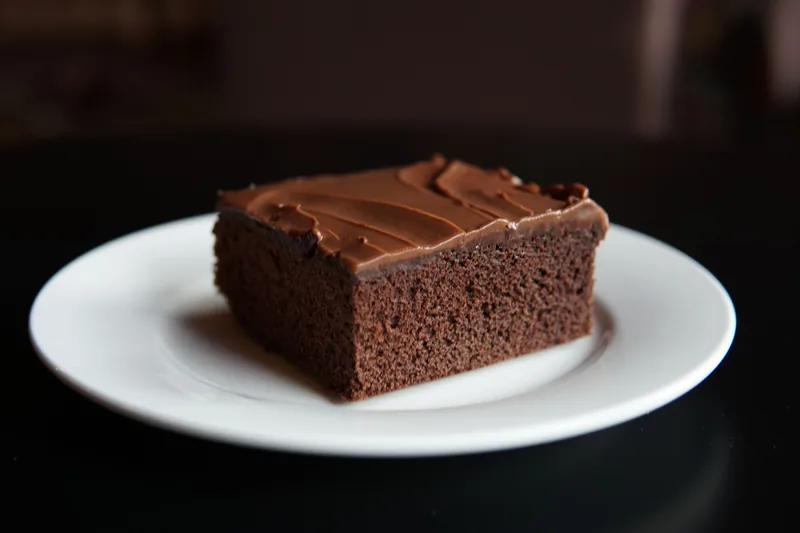
Chocolate Mayonnaise Cake
A Depression-era cake that stays damp for four days. The mayonnaise is the eggs and the oil, and you will never taste it.
- Total time
- 50 min
- Yield
- One 9-inch cake, 12 slices
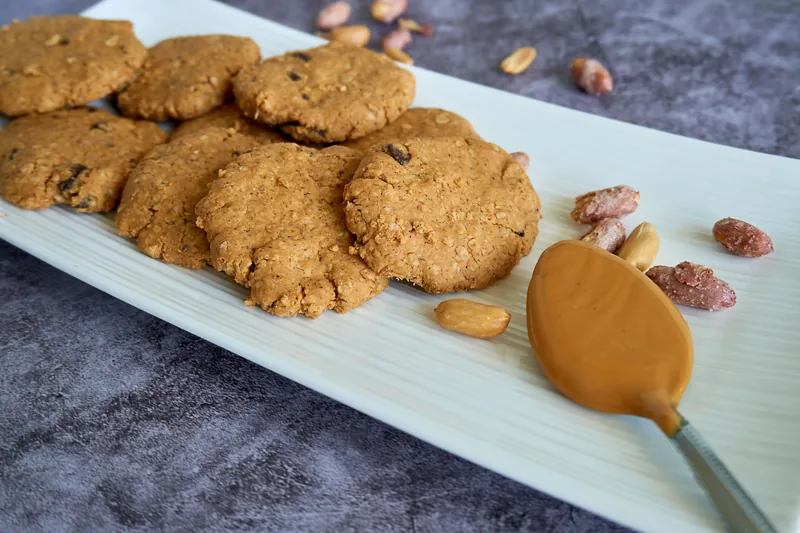
Air Fryer Peanut Butter Cookies
Three ingredients, eight minutes, six cookies at a time. No flour and no oven to heat.
- Total time
- 18 min
- Yield
- Makes 18 cookies
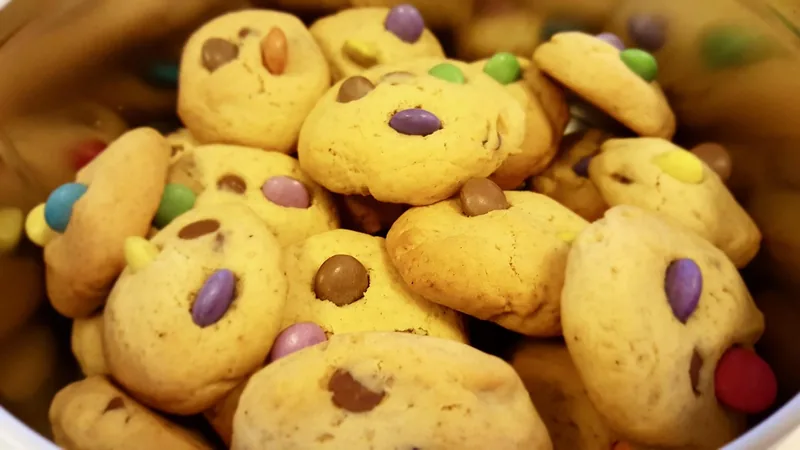
Easter Chocolate Chip Cookies
A brown-sugar chocolate chip dough handled so the candy-shelled eggs keep their pastel shells instead of bleeding into it.
- Total time
- 1 hr 1 min
- Yield
- Makes 24 cookies