Roasted Sweet Potato Bites
Caramelized at the edges, soft inside. High heat, a hot tray, and enough space between the cubes.
- Prep
- 10 min
- Cook
- 30 min
- Makes
- Serves 6
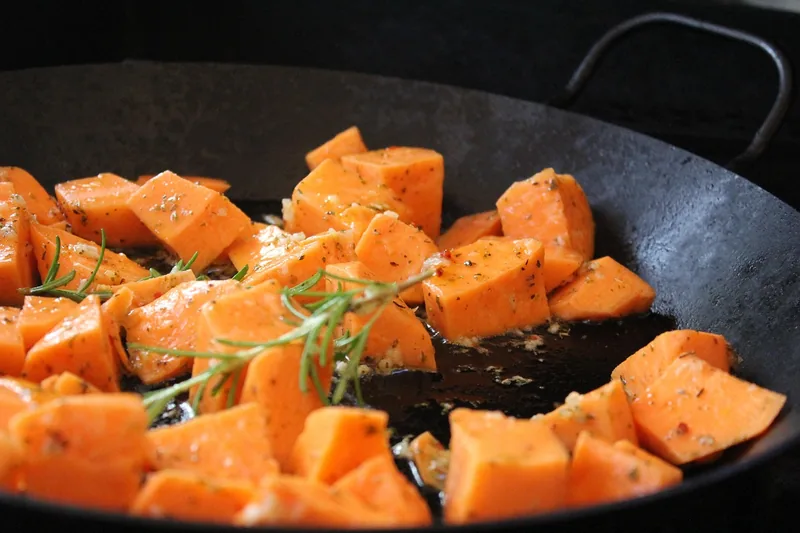
Sweet potatoes behave differently from ordinary ones, and the difference is sugar. They contain far more of it, which means they caramelize readily and burn readily, often on the same tray.
Some of that sugar is not there yet when the cubes go in. Sweet potatoes carry an enzyme that converts their starch into maltose, and it works in a narrow band of temperature — roughly between 135°F (57°C) and 170°F (77°C) — before the heat destroys it. Everything the interior does on its way through that band it does for free, which is why a sweet potato tastes sweeter roasted than boiled, and why a cube the size of a die never tastes of much: it passes through the window in a minute and a half.
Preheat the tray with the oven. Cold cubes on a cold tray sit in their own moisture for the first five minutes and steam; the same cubes hitting metal at 425°F (220°C) start browning on contact. This one change does more than any seasoning.
Bare metal, then. Not parchment and not foil. Parchment insulates the cubes from the surface you just spent twenty minutes heating, and the flat face that should be brown and stuck-looking comes out orange and damp instead. If the tray is well oiled the cubes release on their own once the crust forms.
Space matters more than for anything else here. Sweet potato releases a lot of moisture, and cubes touching each other trap it between them. Two trays, always, even when one looks like it might do.
Cornstarch is the optional extra that makes them properly crisp: a teaspoon tossed through absorbs surface moisture and gelatinizes into a thin shell. It is the same principle as dusting fries before frying.
Season with salt and paprika before, garlic and herbs after. Garlic powder burns and turns bitter over half an hour at this temperature.
What you are looking for at the end is unevenness: mahogany-brown corners and edges, and flat faces that are a deeper orange than they started. The cue is visual and it changes fast. Sugars caramelize from about 320°F (160°C), and the corners of a cube run well ahead of the middle of a face, so the gap between properly caramelized and acrid is roughly three minutes at the end. Check at twenty-eight, not thirty-five.
The other failure is the opposite one, and it is more common: a tray of pale, floppy cubes that taste steamed. That is always crowding or a cold tray, never insufficient time, and adding ten minutes only dries them out. Listen when the cubes land — if they do not sizzle, the tray was not hot enough, and you would do better to take them off, reheat the tray, and start again.
They soften within twenty minutes of coming out. That is not a flaw to fix; a sweet potato holds so much water that the crust reabsorbs it almost immediately, and this is simply a dish to carry straight to the table.
Roasted cabbage steaks want the same treatment and the same tray temperature, and air fryer breakfast potatoes solve the same moisture problem with a different machine. When it is too hot to run an oven at 425°F (220°C) for half an hour, cornmeal patties get you the same crisp-edged side out of a skillet in ten minutes.
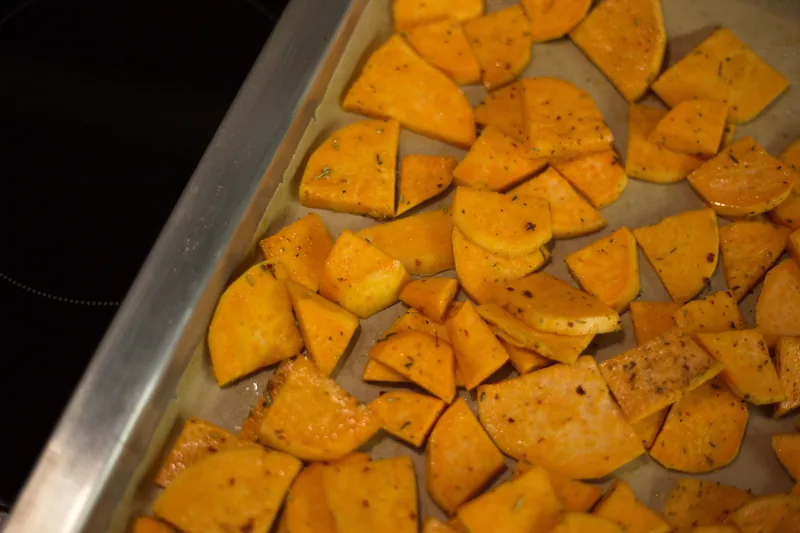
Roasted sweet potatoes: the card
Caramelized at the edges, soft inside. High heat, a hot tray, and enough space between the cubes.
What you need
- 2½ lb (1.1 kg) sweet potatoes, peeled and cut into 1¼-inch (3 cm) cubes
- 3 tbsp olive oil
- 1 tsp cornstarch, optional
- 1 tsp smoked paprika
- 1½ tsp fine salt
- ½ tsp black pepper
- 1 tsp garlic powder, to finish
- 2 tbsp chopped parsley, to finish
How to get roasted sweet potatoes properly caramelized
- 1 Put two baking trays in the oven and heat it to 425°F (220°C) convection. The trays heat with it.
- 2 Toss the cubes with the oil, cornstarch, paprika, salt and pepper until evenly coated.
- 3 Spread them across the two hot trays in a single layer, with space between every cube. They should sizzle as they land.
- 4 Roast 18 minutes, turn each cube, then roast another 10–12 minutes until deeply caramelized at the edges.
- 5 Toss with garlic powder and parsley while hot, and serve straight away.
On cube size, ovens and getting ahead
- They soften within 20 minutes of coming out. This is a dish to serve immediately, not to hold.
- Cubes larger than 1¼ inches (3 cm) brown before the middle is cooked; smaller ones dry out.
- No convection fan: raise the oven to 450°F (230°C) and add about 5 minutes. Still air browns considerably slower.
- The peel is edible and crisps up well — scrub rather than peel if you prefer it, and expect slightly chewier edges.
- Cut them up to a day ahead and hold them in cold water in the fridge. Drain and dry them thoroughly before oiling, or the tray will steam.
- For a sweet-and-smoky version, toss with 1 tablespoon maple syrup and ½ teaspoon chipotle powder for the last 5 minutes only. Added earlier the syrup burns.
Pale cubes, burned edges and reheating
Crowded tray, cold tray, or both. Sweet potato gives off a lot of steam, and steam trapped between cubes keeps the surface at 212°F (100°C) — well under the temperature anything browns at. Two trays, preheated, with a gap around every cube.
The cubes were too big, or they sat on the top rack where the heating element radiates directly onto them. Keep to about 1¼ inches (3 cm) and roast in the middle of the oven. The sugar at a thin corner reaches burning temperature long before the center of a large cube is even hot.
No. The skin is thin and turns pleasantly chewy at this heat. Scrub them well, since roasting concentrates whatever is on the outside along with everything else.
Yes, and it suits them: 400°F (200°C) for 15–18 minutes, shaking twice. You will need two batches for this quantity, because the same crowding rule applies in a smaller basket.
Spread them on a hot tray at 400°F (200°C) for 8 minutes, or 5 minutes in an air fryer. A microwave brings the reabsorbed water straight back to the surface and you get something closer to mash.
More healthy snacks
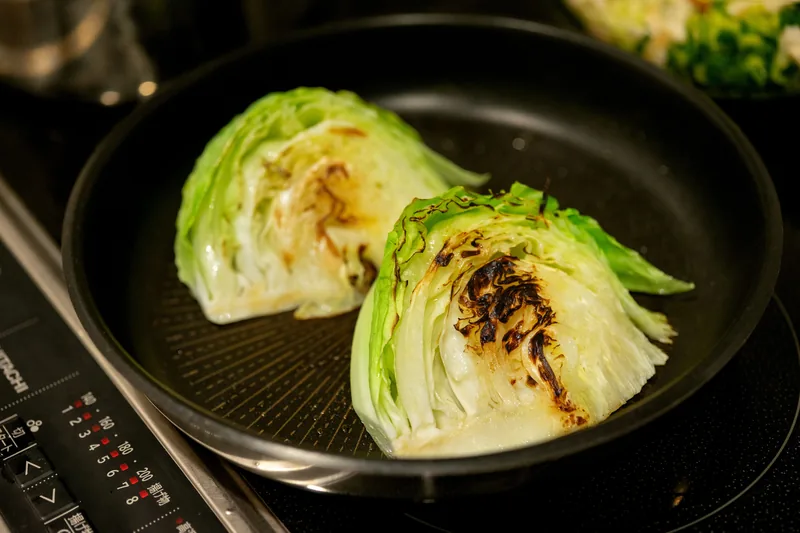
Roasted Cabbage Steaks with Yogurt Sauce
Thick wedges roasted until the edges char and the core turns sweet, under a cold garlic yogurt.
- Total time
- 45 min
- Yield
- Serves 4
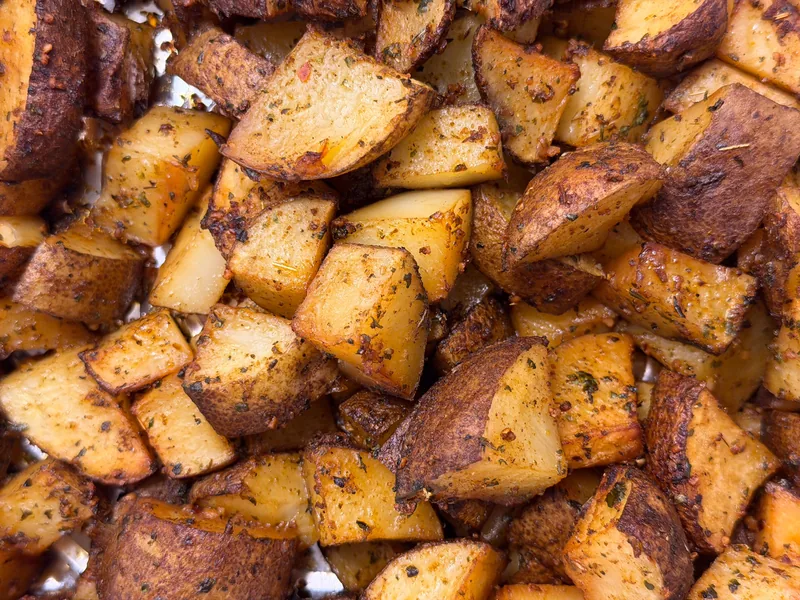
Crispy Air Fryer Breakfast Potatoes
Parboiled, roughed up, then air-fried hard. Craggy outside, fluffy inside, twenty minutes.
- Total time
- 32 min
- Yield
- Serves 4
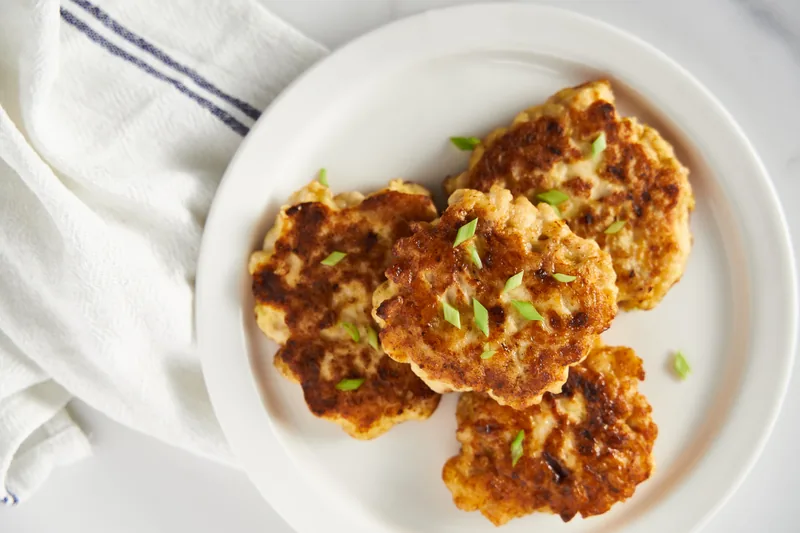
Cornmeal Onion Patties
A thick buttermilk cornmeal batter packed with finely chopped onion, shallow-fried crisp at the edges and tender through the middle.
- Total time
- 27 min
- Yield
- Makes 8 patties